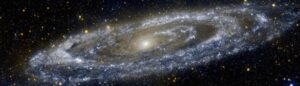
What may be known about God is plain to [people],
because God has made it plain to them.
For since the creation of the world God’s invisible qualities
—his eternal power and divine nature—
have been clearly seen, being understood from what has been made,
so that people are without excuse.
(Romans 1:19-20)
I have always believed in God. Of course, I was taught this as a young child, but it became my belief too. I looked at creation, stars, babies (and there were a lot in my family.) They didn’t just appear. Someone had to do something for them to show up. Simply put: if something exists, it had to come from somewhere. If something is started, someone had to start it.
So why we believe in God is probably the best why to start with since all the others seem to hang on this one. This will not be an exhaustive list.
I have been reading Is Atheism Dead? by Eric Metaxus. He lists many, many reasons why believing in God is a rational response scientifically. Many believe that faith and science cannot co-exist, but as men study the science of earth, many have come to believe in God after discovering the complexity of creation, from the universe to the human body. Even some of those who adamantly refuse to believe in God acknowledge the intricate design of our world and the whole universe.
Where did the universe come from? How did the earth come to be? And how did the animals, plants and people start? People have been asking that question for a long time. Many physicists, astronomers and other scientists have searched for answers. Men have been looking into the heavens in awe, looking for answers, for a long time.
In 1924, Edwin Powell Hubble, using a one-hundred-inch telescope (even before the Hubble telescope), discovered what no one before him had seen. The universe was not static – was not always the same. It was expanding! All the stars and galaxies in our universe were moving farther and farther from each other. Hubble’s protégé, Allan R. Sandage, continued studying the universe. It was said of Sandage that he “had become the first person in history whose job description was to determine the fate of the universe.” Sandage was already a God-believer.
To give you just a taste of what has been discovered, I’ll tease you with these facts.
Since the universe is expanding, the scientists worked the numbers backwards to the point where the universe was one singularity. I didn’t know that word outside of Star Trek, but it’s a real scientific thing! If the universe is expanding, that means yesterday all the planets and stars were closer to each other, and the day before that even closer. If we go far enough back, it would have been one big mass. The scientists have calculated that 13.8 billion years ago the universe was a singularity! I didn’t know that “singularity” existed beyond Star Trek, but it is a real thing! Sir Fred Hoyle, another scientist who believed this was all pseudoscience (fake science), sarcastically dubbed this idea The Big Bang Theory during a radio broadcast. It wasn’t his intention, but the name stuck.
No one has seen a singularity, but since the universe is expanding, back through time, at one point it was so compact that it was a “singularity,” it had to come from somewhere and someone. Personally, I believe in the Big Bang Theory. God said “Let there be light” and “Bang!” there was light.
As you can imagine, a bang that huge would release an enormous amount of energy. Einstein showed that matter and energy are different forms of the same thing. Mass turns into energy and energy turns into mass, but they don’t end. (I can’t say I understand that. I hated Physics.) But the point is that the energy/radiation from the Big Bang is still hanging around beyond our galaxy, and has been found and measured!
Still, some scientists refuse to acknowledge that there is a Designer / Originator that we call God. Someone that big and powerful would demand attention, respect and honor.
Here is a quote from (Is Atheism Dead? Chapter 3, The Fine-Tuned Planet)
“The most famous atheist in the world was riding in the back of a car. Suddenly, someone from the front seat put a camera in his face and asked him which argument was the best from the ‘other’ side – meaning the side that argued for the existence of God.”
This was Christopher Hitchens, who had debated many noted God-believers. He delighted in humiliating his opponents at any cost. The man with the camera asked what argument of theirs was worthy of their debate? Hitchens answered,
“It is the fine-tuning argument, he said. “The fine-tuning, that one degree, well one degree, one hair [of difference]… even though it doesn’t prove design, doesn’t prove a Designer… You have to spend time thinking about it, working on it, It’s not a trivial [argument.] We all say that.”
Who are the “we all” who are saying that? He is including Richard Dawkins, Daniel Dennett and Sam Harris. They were famous atheists trumpeting their beliefs and knocking anyone who dared believe in a Designer. They were aware of the evidence of science, but chose not to believe in an Intelligent Designer. Steven Hawking (another well known atheist) wrote in his book A Brief History of Time, “It would be very difficult to explain why the universe would have begun in just this way, except as the act of a God who intended to create beings like us.” (Also quoted from Is Atheism Dead?.)
Here are a few of the fine-tuned aspects of our earth that make even atheists scratch their heads.
- The size of our earth. If earth were smaller, or larger, the magnetic poles would either be too strong or too weak. Too weak and solar winds would strip away our atmosphere. Too strong and our atmosphere would be too thick to breath.
- The distance from the sun. Too close and all the water evaporates. Life could not exist. Too far and everything would freeze.
- The size of the planets. The larger planets of our solar system – Jupiter and Saturn – either deflect asteroids away from earth by their gravitational pull, or actually pull them into themselves.
- The size of the Moon. We are the only planet with just one moon, and one large enough in relation to earth’s size. The moon is 27% the size of Earth; it is big enough with enough gravitational pull to affect our tides and keeps the tilt of the earth constant. Earth wobbles very little and this stabilizes our seasonal climates.
We’ve been talking about how the universe itself points to God, but there are other clues. These are not so technical but seem to be common sense – at least to me.
For example, it makes sense that if something is started, something or someone had to do the starting. Nothing comes from nothing. We can make stuff if we have the right raw materials. But someone had to make the raw materials.
Coming at this from another direction, mankind is naturally inclined to seek out what is “beyond” themselves. Every time archeology has discovered a new people group, there is always a “god” for that people group. It is a basic human trait to recognize there are some things we don’t understand and cannot control. I have a friend who doesn’t believe in God but loves novels that delve into the supernatural and magic. She has a God-given hunger for Him but is still looking in all the wrong places. Again, every people group, from ancient times until now, has had their own gods, their own seeking of what is beyond themselves. That built-in hunger, that God-shaped hole in each and every one of us, was put there to draw us to Himself. Our Father, Our God, Our Creator longs for relationship with us, and has built that same longing into us. Hallelujah!
Wonderful Terry! Well Said! Thanks for bringing in so much scientific information.